
Metal braces are the treatment most people picture when they think of orthodontics, and for good reason. Traditional metal braces have been refined over decades, they handle nearly any alignment or bite issue, and they typically cost less than ceramic, clear aligner, or lingual alternatives. For a lot of my patients in Brentwood and Nashville, from teenagers getting their first set of braces to adults finally addressing a lifelong bite issue, metal braces are simply the most efficient and reliable path to a straighter smile.
At Starling Orthodontics, we offer metal braces alongside 3M Clarity Advanced ceramic braces, 3M Clarity clear aligners, and WIN lingual braces. We don't push every patient toward the same appliance. Metal braces earn their place in our treatment plans because for many cases, they are still the most direct and cost-effective way to get predictable results.

Traditional metal braces work well across a wide age range, from children in Phase 1 treatment through teens and adults. Because the brackets are bonded directly to the tooth and the arch wire applies continuous, controlled force, metal braces can move teeth in ways that removable trays sometimes can't manage on their own, particularly in cases involving significant rotation or vertical movement.
Metal braces may be a good option for patients who:
Metal braces aren't the automatic answer for every patient, and we will say that honestly. Adults in client-facing careers often prefer the discretion of ceramic braces, clear aligners, or lingual braces- even if metal braces would technically work just as well clinically. Some patients with only mild crowding are better candidates for clear aligners. Part of our job during your consultation is helping you weigh the trade-offs between effectiveness, cost, comfort, and appearance so you choose the option that actually fits your life.
Braces for teens are still one of the most common reasons families come through our doors, and metal braces are frequently the right call at this age. Most permanent teeth have erupted by the early teen years, which makes it a practical window to correct crowding, spacing, and bite issues before they become more complicated to treat later on.
Teens also tend to be excellent candidates for metal braces specifically because the appliance doesn't depend on daily compliance the way removable aligners do. There's no tray to lose, forget at school, or skip wearing before a big event. The arch wire is doing its job around the clock, which often makes treatment timelines more predictable for this age group.

A few things I talk through with teen patients and their parents:
It's a common misconception that braces are just for kids and teens. I treat a steady stream of adult patients with metal braces, whether they never had orthodontic treatment growing up or their teeth have shifted since a prior round of braces or retainer wear.
Metal braces work exactly the same way for adults as they do for teens, biologically. The main difference is that adult patients are often weighing visibility more heavily against their profession or social life, which is why I make sure to walk through ceramic, clear aligner, and lingual alternatives at the consultation too. For adults who don't mind the visibility trade-off, metal braces are often the fastest and most affordable route to the result they want.
A few things adult patients ask about most:
Treatment starts the same way regardless of which appliance we end up recommending: a full evaluation of your teeth, bite, and oral health. If metal braces are the right call, I'll walk you through the specifics of your treatment plan, including which teeth need the most movement and roughly how long that process will take.

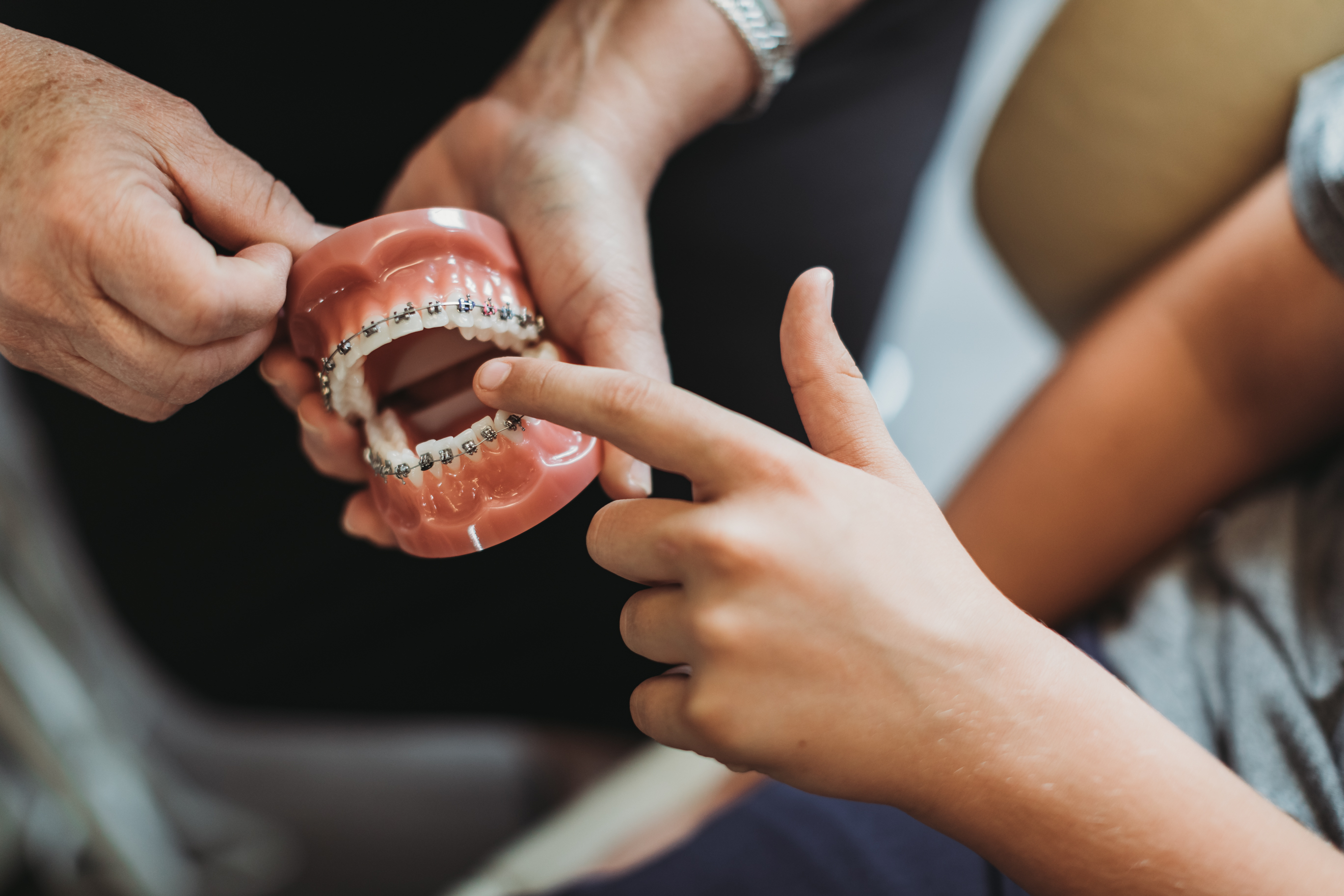
At the placement appointment, I bond a small stainless steel bracket to the front surface of each tooth and thread an arch wire through them. The wire is what does the actual work, applying steady pressure that shifts teeth into position over time. Small elastic or metal ties hold the wire in place at each bracket, and you'll swap those out at your adjustment visits.
Most patients notice some general soreness for the first few days after placement or after an adjustment, as teeth respond to new pressure. This is a normal part of the process and typically fades within a week. During treatment, you'll come in every four to eight weeks so I can tighten or replace the arch wire, check on how your bite is progressing, and make sure everything is tracking with the original plan.
A few things to expect during treatment:
Timelines with metal braces vary based on how much correction is needed. Mild cases can wrap up in under a year, while more involved bite corrections can take two years or longer. Because metal braces apply continuous force around the clock rather than depending on you to wear a removable device consistently, treatment time is often more predictable than it would be with an aligner-based approach for the same case.
A few factors that affect your timeline:
I'll give you a realistic timeline at your consultation once I've had a chance to evaluate your teeth and bite directly. Estimates given without an exam aren't reliable, so I avoid giving them.
Metal braces are typically the most budget-friendly fixed orthodontic option we offer. In 2026, traditional metal braces at Starling Orthodontics generally range from $4,000 to $7,000, depending on the complexity and length of treatment. That compares to $4,500 to $7,500 for ceramic braces, and more for WIN lingual braces given the custom fabrication involved.
We accept most PPO insurance plans, and orthodontic benefits typically contribute $1,000 to $2,000 toward the total cost when a plan includes them. For patients paying out of pocket or covering the difference, we offer in-house payment plans and accept CareCredit® financing so treatment can be spread out monthly rather than paid in one lump sum.
A few things worth knowing as you budget:
Since I offer multiple appliance systems, patients often ask how metal braces stack up against the alternatives. Here's a straightforward comparison:
There isn't a universally "best" option among the three. Metal braces tend to be the most efficient and affordable choice when appearance isn't the primary concern. If you're weighing lingual braces specifically, our lingual braces page goes into more detail on how that system works.
Patients throughout Brentwood, Nashville, and the surrounding Williamson County communities choose Starling Orthodontics because every treatment plan starts with an honest conversation, not a default recommendation. We take the time to understand your goals, your budget, and your lifestyle before suggesting an appliance, and we will tell you plainly if a less expensive option like metal braces will get you the same result as something pricier.

A few things patients consistently mention:
Do metal braces hurt more than other types of braces?
Not inherently. Soreness after placement or adjustments is common with any fixed appliance, metal, ceramic, or lingual, as teeth respond to new pressure. Most patients find the discomfort mild and short-lived, easing within a few days.
Are metal braces faster than clear aligners?
For complex cases, metal braces often move teeth more predictably because they apply constant force without relying on the patient to wear a removable device consistently. For milder cases, clear aligners can sometimes work in a comparable timeframe. I'll compare both options directly for your specific case during your consultation.
What age is best for braces for teens?
Most teens are ready for braces once their permanent teeth have largely come in, typically between ages 11 and 14, though every patient develops on a different timeline. An evaluation is the only reliable way to know if your teen is ready now or would benefit from waiting.
Can adults get metal braces?
Yes. I treat adults with metal braces regularly, and there's no upper age limit for orthodontic treatment as long as your teeth and gums are healthy enough to support tooth movement.
How do I keep my teeth clean with metal braces?
Brushing after meals and flossing daily are still the foundation, though brackets and wires take a bit more care to navigate. I'll walk you through the specific tools and technique that make it manageable, including any recommended flossing aids.
What happens if a bracket comes loose?
Call our office and we'll get you in to fix it. A loose bracket usually isn't an emergency, but it's worth addressing promptly so your treatment plan stays on track.
How is this different from ceramic or lingual braces?
All three use the same basic bracket-and-wire mechanism, but they differ in visibility, material, and cost. Metal braces are the most visible and generally the least expensive; ceramic braces blend in more with tooth color; WIN lingual braces are placed behind the teeth and are completely hidden, at a higher cost due to custom fabrication.
The best way to know which appliance fits your case, budget, and lifestyle is a consultation. I'll evaluate your bite and alignment, walk you through your options honestly, including metal, ceramic, clear aligners, and lingual braces, and help you land on the choice that makes sense for you, whether you're a teen getting your first set of braces or an adult finally getting around to it.
Schedule your free consultation today: call (615) 507-1660 or request an appointment online at starlingorthodontics.com. We serve patients from Brentwood, Nashville, Franklin, Nolensville, and throughout Williamson County.

Please call (615) 507-1660 or click below to schedule a consultaion appointment online.

Please call (615) 507-1660 or click below to schedule your complimentary orthodontic consultation online.


