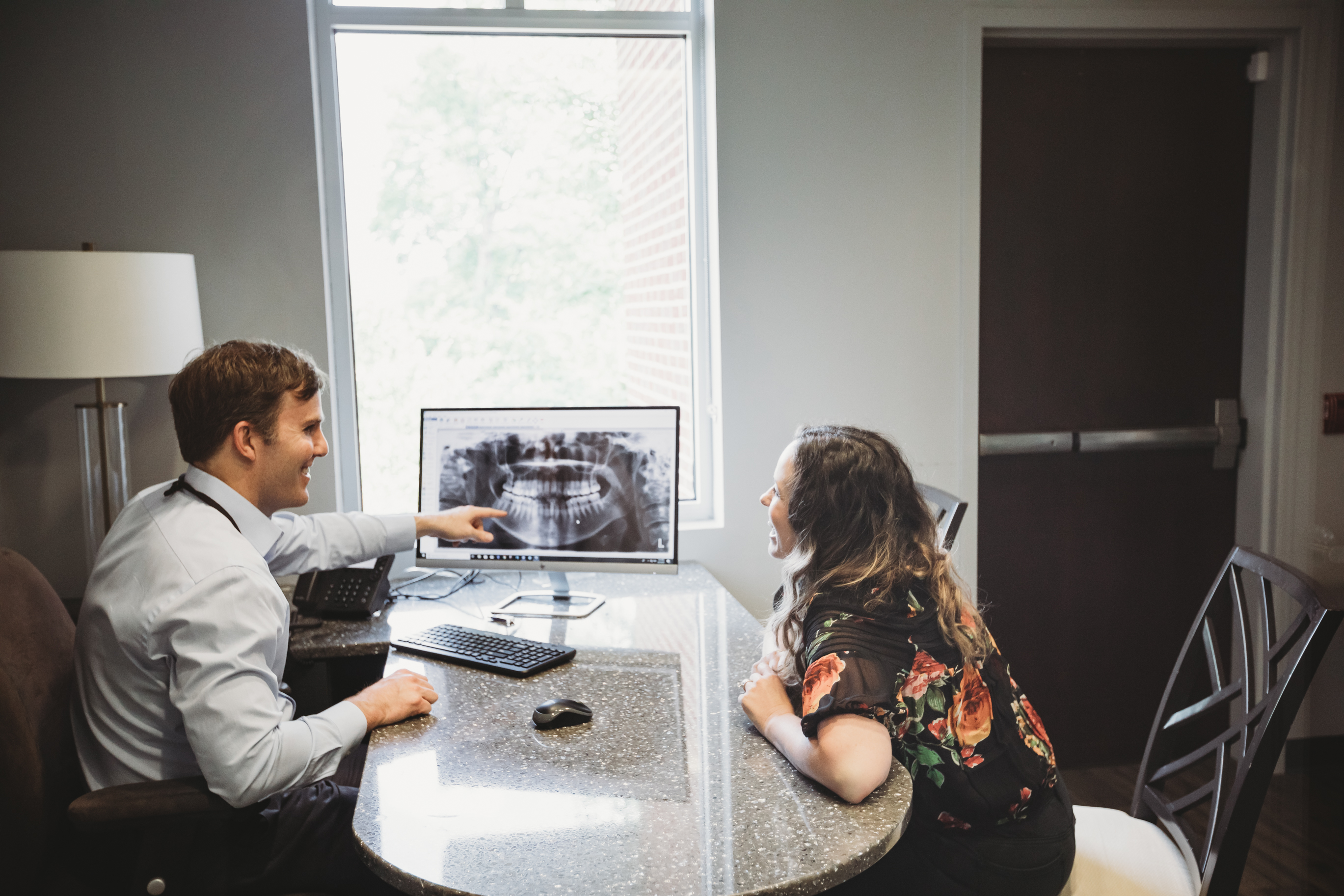
For most patients, braces, clear aligners, or TADs are enough to correct a misaligned bite. But when the discrepancy isn't just about tooth position, when the upper and lower jaws themselves don't line up correctly, orthodontics alone has limits. Surgical orthodontics combines orthodontic treatment with jaw surgery (orthognathic surgery) to correct these skeletal issues directly, rather than trying to disguise them by moving teeth alone.
We have extensive experience with surgical orthodontic cases and work closely with oral and maxillofacial surgeons (OMFS) here in the Nashville area throughout the process. Surgery isn't a path we suggest lightly, and for most patients, it's not the right fit. But for the right case, it's often the treatment that delivers the most stable, functional, and long-lasting result, sometimes the only treatment that truly can.
Here's how to know if surgical orthodontics might apply to your case, and what the combined process actually looks like.
Most orthodontic cases are dental, meaning the teeth are misaligned but the jaws themselves are proportioned normally. Surgical cases are different: the jaws are the source of the problem, not just the teeth sitting on top of them. A few reasons a patient might need or benefit from surgical orthodontics:
The jaws don't line up, no matter how the teeth are positioned. In some patients, the upper and lower jaw are simply different sizes or positioned differently relative to each other. Moving teeth can sometimes compensate for a mild version of this, but for a moderate to severe skeletal discrepancy, the jaws themselves need to be repositioned to get a bite that actually functions correctly.
A significant overbite, underbite, or open bite. When the front teeth protrude significantly, sit well behind the upper teeth, or don't meet at all even with the back teeth together, the cause is frequently skeletal rather than purely dental. These cases often respond better, and more permanently, to a combined surgical approach than to orthodontics alone.
Facial asymmetry. If the jaw is noticeably off-center or one side has grown differently than the other, orthodontic tooth movement can't correct the underlying skeletal asymmetry. Jaw surgery can realign the jaw itself, which orthodontics then fine-tunes.
Difficulty chewing, biting, or speaking. A significant jaw misalignment can affect basic function, not just appearance. When a bite discrepancy is severe enough to interfere with everyday function, correcting the skeletal cause, rather than working around it, often produces a meaningfully better outcome.
Jaw-related sleep apnea or airway concerns. In some cases, jaw position contributes to breathing or airway issues during sleep. Repositioning the jaw surgically can, in coordination with a physician, be part of addressing the underlying structural cause.
Wanting a stable result rather than a compensated one. For borderline cases, it's sometimes possible to camouflage a skeletal discrepancy using orthodontics alone, moving teeth to create a workable bite without correcting the jaw itself. That approach can work, but it sometimes comes at the cost of long-term stability, facial balance, or how natural the bite feels. We'll always tell you honestly when a non-surgical option is a reasonable choice, and when surgery would likely give you a better, more durable result.
Surgical orthodontics tends to have a reputation as a bigger, scarier version of "regular" treatment, something to avoid if at all possible. For the right case, that framing misses the point. When a bite problem is truly skeletal, jaw surgery is often the treatment that actually solves the underlying issue, rather than working around it.
A few reasons surgery is sometimes the better long-term choice, not just an alternative:
Surgical orthodontic cases are a genuinely collaborative process between our office and an oral and maxillofacial surgeon here in the Nashville area. We stay closely involved with the surgical side of your case, not just the orthodontic side, so your treatment plan holds together from start to finish.
Pre-surgical orthodontics. Before surgery, we align your teeth within each jaw so they'll fit together correctly once the jaws are repositioned. This phase typically takes twelve to eighteen months, and your bite may look slightly worse before surgery as the teeth are being properly positioned, this is expected and part of the plan.
The surgery itself. The OMFS surgeon we're coordinating with performs the jaw surgery, repositioning the upper jaw, lower jaw, or both to correct the skeletal discrepancy. We stay in contact with the surgical team throughout planning to make sure the surgical plan and the orthodontic plan match up precisely.
Post-surgical orthodontics. After a recovery period, we finish refining your bite with orthodontic treatment, fine-tuning the final tooth positions now that the jaws are correctly aligned. This phase typically takes six to twelve months.
Total combined treatment time generally runs eighteen to thirty months from the start of pre-surgical orthodontics through the completion of post-surgical refinement, though every case is different. We'll map out a realistic timeline for your specific case at your consultation.
Because surgical orthodontic treatment involves both our office and an oral and maxillofacial surgeon, costs are split between two providers: our orthodontic fees for the pre- and post-surgical phases, and the surgeon's fees for the procedure itself, which is often billed through medical insurance rather than dental insurance since it's classified as a medical procedure.
Orthodontic fees for a surgical case at Starling Orthodontics generally range from $6,000 to $9,000, in addition to the surgeon's fees, which we can help you understand and coordinate as part of your treatment planning. Many medical insurance plans provide meaningful coverage for orthognathic surgery when it's medically necessary, and we'll help you understand what to ask your insurance provider before treatment begins.
We accept most PPO dental insurance plans for the orthodontic portion of treatment, and we offer in-house payment plans and CareCredit® financing to help manage costs across the full course of treatment.
How do I know if I need jaw surgery or if braces alone will work?
A thorough evaluation, including a look at your bite, jaw position, and facial profile, is the only reliable way to know. Many patients who assume they need surgery don't, and some patients who don't expect to need it do. We'll give you an honest assessment either way.
Is jaw surgery only for severe cases?
Generally, yes. Most orthodontic cases, even fairly significant ones, can be treated with braces, clear aligners, or TADs alone. Surgery becomes the better option specifically when the discrepancy is skeletal (in the jaw bones themselves) rather than purely dental.
Will I need braces before and after surgery?
Yes, in nearly all cases. Pre-surgical orthodontics prepares your teeth so they'll fit together properly once the jaws are repositioned, and post-surgical orthodontics fine-tunes the bite after healing. Surgery alone, without orthodontic treatment on both sides, typically isn't done.
How long does recovery from jaw surgery take?
Initial recovery is generally a few weeks, though your surgeon will give you a specific timeline based on your procedure. Full healing and bone stabilization takes longer, which is part of why post-surgical orthodontics doesn't begin immediately.
Who performs the actual surgery?
An oral and maxillofacial surgeon (OMFS) performs the surgical procedure. We coordinate closely with the surgical team throughout your case, from initial planning through your post-surgical orthodontic treatment, but the surgery itself takes place with the OMFS surgeon, not in our office.
Does insurance cover jaw surgery?
Often, at least partially, since orthognathic surgery is frequently classified as a medical rather than purely cosmetic or dental procedure when it's addressing a functional issue. Coverage varies by plan, and we'll help you understand what questions to ask your insurance provider.
Surgical orthodontic cases require a level of coordination and experience that not every orthodontic practice regularly handles. Patients throughout Nashville, Brentwood, and Williamson County trust Starling Orthodontics with these more complex cases because we've built real, working relationships with the oral and maxillofacial surgeons we coordinate with, and because we're honest about when surgery is, and isn't, the right path.
A few things patients consistently mention:
If you've been told you might need jaw surgery, or you've noticed your bite, jaw, or facial profile doesn't seem to line up the way it should, an evaluation is the best next step. We'll assess your case honestly, and if surgery is the right path, we'll walk you through exactly what that process looks like from start to finish.
Schedule your consultation today: call (615) 507-1660 or request an appointment online at starlingorthodontics.com. We serve patients from Nashville, Brentwood, Franklin, Nolensville, and throughout Williamson County.

Please call (615) 507-1660 or click below to schedule a consultaion appointment online.

Please call (615) 507-1660 or click below to schedule your complimentary orthodontic consultation online.


