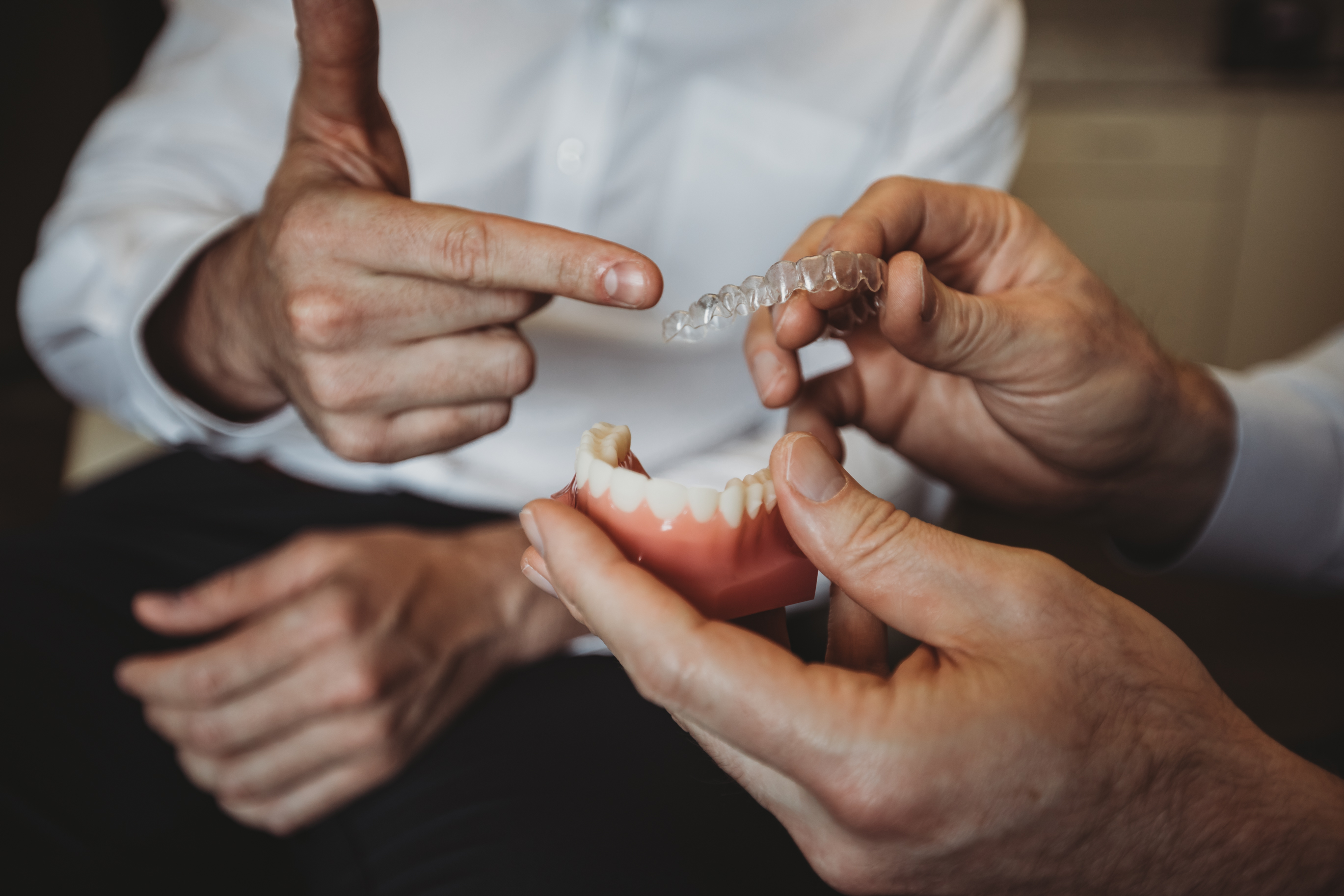
Considering Invisalign aligners or braces? This article will breakdown some of the pros and cons for you. Please note that Invisalign is a brand of clear aligner, and we will refer to it as "clear aligners" from here on out since there are quite a few different systems in use today. The goal is compare the different orthodontic options in general, not a specific brand.
Choosing between clear aligners and traditional braces affects treatment visibility, daily comfort, maintenance requirements, and treatment capabilities. The right choice depends on your specific orthodontic needs, lifestyle preferences, and treatment complexity. Below is a comprehensive comparison from an orthodontic perspective to help you make an informed decision.
As an orthodontist practicing in Nashville, I’ve helped thousands of patients navigate this exact decision. Both clear aligners and braces can deliver beautiful, healthy smiles when matched to the appropriate case. Let me walk you through what the research shows and what I see in my practice every day.
The fundamental difference between these treatment options comes down to fixed versus removable systems.
Traditional braces use metal brackets bonded directly to your teeth, connected by metal wires and elastic bands that apply continuous force. They’ve been the backbone of orthodontic care for over a century, evolving from bulky early designs into today’s smaller, more efficient systems.
Clear aligners take a completely different approach. These removable aligners are custom-made plastic trays that fit snugly over your teeth. Each set is slightly different from the last, gradually moving your teeth into their correct position through gentle pressure.
Both clear aligners and braces effectively straighten teeth using controlled forces. The key differences lie in visibility, how they’re worn, and which orthodontic problems they handle best. In my Nashville practice, I’ve found that both treatment methods produce excellent results when we select the right approach for each patient’s unique situation.
For many adult patients and teens, appearance during treatment is a significant concern. Let me break down what you can expect from each option.
Clear aligners are made from clear, medical-grade plastic, making them virtually invisible when worn. This discreet appearance is a significant advantage for adults concerned about their appearance during treatment.
In my experience, clear aligner patients report greater confidence vs traditional braces in professional and social settings. Whether you’re presenting in a boardroom or attending a wedding, most people won’t even notice you’re undergoing orthodontic treatment. Recent patient satisfaction studies confirm what I see daily: aligner wearers consistently rate aesthetics clear aligners provide higher than those wearing conventional braces.
While traditional braces are more visible due to their metal brackets and wires, modern advancements have made them smaller and less conspicuous than in the past. Today’s brackets are significantly lower-profile than what your parents might remember.
Ceramic braces use clear or tooth-colored brackets that blend in better with the natural color of teeth compared to traditional metal braces, making them a more aesthetic option for patients who need fixed appliances but want improved cosmetics.
Lingual braces, which attach behind the teeth, offer another alternative but come with higher costs and an adjustment period for speech (as do clear aligners as well).
Understanding how each system moves teeth helps explain why one might work better for your specific situation. This is where the science really matters.
Clear aligners use a series of plastic aligners to create precise tooth movement through tipping forces primarily applied to the visible part of your teeth (the crown). Each aligner makes small adjustments, and you switch to a new set approximately every one to two weeks.
Research shows Invisalign has a success rate of approximately 88%, with treatment being generally more effective for mild to moderate orthodontic issues. A 2020 prospective study published in orthodontic journals found that overall movement accuracy withclear aligners averages around 50%, with the highest accuracy (approximately 56%) seen in side-to-side crown tipping movements.
However, the same research revealed limitations with complex cases. Certain movements remain challenging:
For crowding, mild spacing, and mild to moderate bite problems, clear aligners perform comparably to braces. But for complex orthodontic issues requiring significant rotation or vertical changes, traditional braces remain the more reliable choice.
Traditional braces apply continuous force through their wire systems 24 hours a day, providing superior control for complex cases. The brackets and wires work together to create three-dimensional tooth movement, including rotation, bodily movement (moving both the crown and root together), and precise vertical adjustments.
Braces have a success rate of approximately 90% and are recognized as the “gold standard” for complex orthodontic issues. Systematic reviews confirm that for severe rotations, extraction cases, skeletal discrepancies, and bite corrections requiring precise control, fixed appliances outperform clear aligners in predictability and efficiency.
The fixed nature of braces ensures treatment progresses without the risk of patient forgetfulness, while clear aligners rely on patient compliance. When a case requires aggressive or unpredictable movements, braces typically provide greater control over tooth movement, making them more suitable for severe alignment issues.
Both treatment types require an adjustment period, but the day-to-day experience differs considerably.
Clear aligners are made from smooth plastic, which means there are no sharp edges or wires, making them generally more comfortable than traditional braces, which can cause soreness after adjustments.
Patients wearing aligners may feel pressure when switching to a new aligner, but this discomfort usually fades after a day or two. One comparative study measured peak discomfort levels and found significantly lower pain ratings for aligners compared to braces in the first 24 hours after beginning treatment.
You might notice temporary speech changes during the first few days with new aligners, but most patients adapt quickly. The smooth plastic surfaces mean less irritation to your cheeks, lips, and tongue throughout treatment.
With braces, expect adjustment soreness following wire changes every 4-6 weeks. This discomfort typically lasts one to two weeks as your teeth respond to the new forces.
Traditional braces can irritate the cheeks or lips due to their fixed nature. Orthodontic wax becomes your friend during these periods, cushioning any brackets that rub against soft tissue. Most patients adapt within the first few weeks and report that subsequent adjustments become easier to manage.
Your daily routines will change with either treatment option, but the nature of those changes differs.
Clear aligners require patients to wear aligners for 22 hours a day for effective treatment, which necessitates discipline in daily routines. You’ll remove them only for eating, drinking anything besides water, and oral hygiene.
The good news? With aligners, there are no dietary restrictions as aligners can be removed before eating. Enjoy your favorite foods without worry. Clear aligners allow for easier oral hygiene since the aligners can be removed for brushing and flossing normally. Simply brush and rinse your aligners, and you’re good to go.
The trade-off is responsibility. Losing aligners or failing to wear aligners the required hours can delay treatment or reduce outcomes. I tell my patients that aligner treatment works best for those who are organized and committed.
Braces offer what I call the “set it and forget it” approach. They work continuously without requiring you to remember to put anything back in your mouth.
However, patients using traditional braces must avoid certain foods that could damage the brackets and wires, such as hard, sticky, or chewy items. Think popcorn, caramel, hard candies, and nuts. These dietary restrictions add to the maintenance effort.
Maintaining oral hygiene with braces is more challenging, as patients need to learn specialized techniques for brushing and flossing around the brackets and wires to prevent plaque buildup. Investing in interdental brushes and possibly a water flosser makes a significant difference in keeping teeth properly cleaned. Regular office visits every 4-8 weeks keep treatment on track.
How long will you be in treatment? The answer depends on complexity and compliance.
Treatment time for aligners typically less, but usually the malocclusion are less complex. Traditional braces typically require 18–24 months for most cases. The average treatment time for braces ranges from 18 months to 3 years, while clear aligner treatment can take 12 to 24 months for mild to moderate cases, but may extend for more severe cases.
In my Nashville practice, I’ve found that patient compliance dramatically impacts timeline success with any clear aligner treatment. When patients don’t wear their aligners consistently, movement stalls, refinement stages multiply, and treatment time extends beyond original estimates- sometimes quite a bit more.
With braces, treatment pace depends primarily on your biological response and keeping scheduled appointments. The teeth gradually move according to the treatment plan without relying on daily patient decisions.
For simple spacing or mild crowding, some clear aligner patients complete treatment in as little as 6-9 months. Complex cases requiring significant bite correction typically proceed more efficiently with braces.
Let’s talk about what matters to most families: the investment.
The overall cost of clear aligners and traditional braces is similar, typically ranging from $3,000 to $8,000 depending on factors like location and case complexity. In Nashville, treatment costs generally fall in the $3,500-$8,000 range depending on the specifics of your case.
Traditional metal braces are generally the most affordable option, costing between $3,000 and $7,000, while ceramic braces are slightly just more expensive. In many cases, the cost of clear aligners are comparable to that of traditional braces, with some patients finding that clear aligners may not be more expensive than braces after all.
Many dental insurance plans cover braces, and good news: dental insurance plans typically treat both orthodontic treatment options similarly. Most plans provide a lifetime maximum benefit for orthodontics (often $1,000-$2,000) regardless of whether you choose braces vs clear aligners.
Flexible payment plans are available at most orthodontic practices, including mine, making either option accessible for families. When considering value, remember that both treatments straighten teeth effectively when properly selected, and the long-term oral health benefits far outweigh the initial investment.
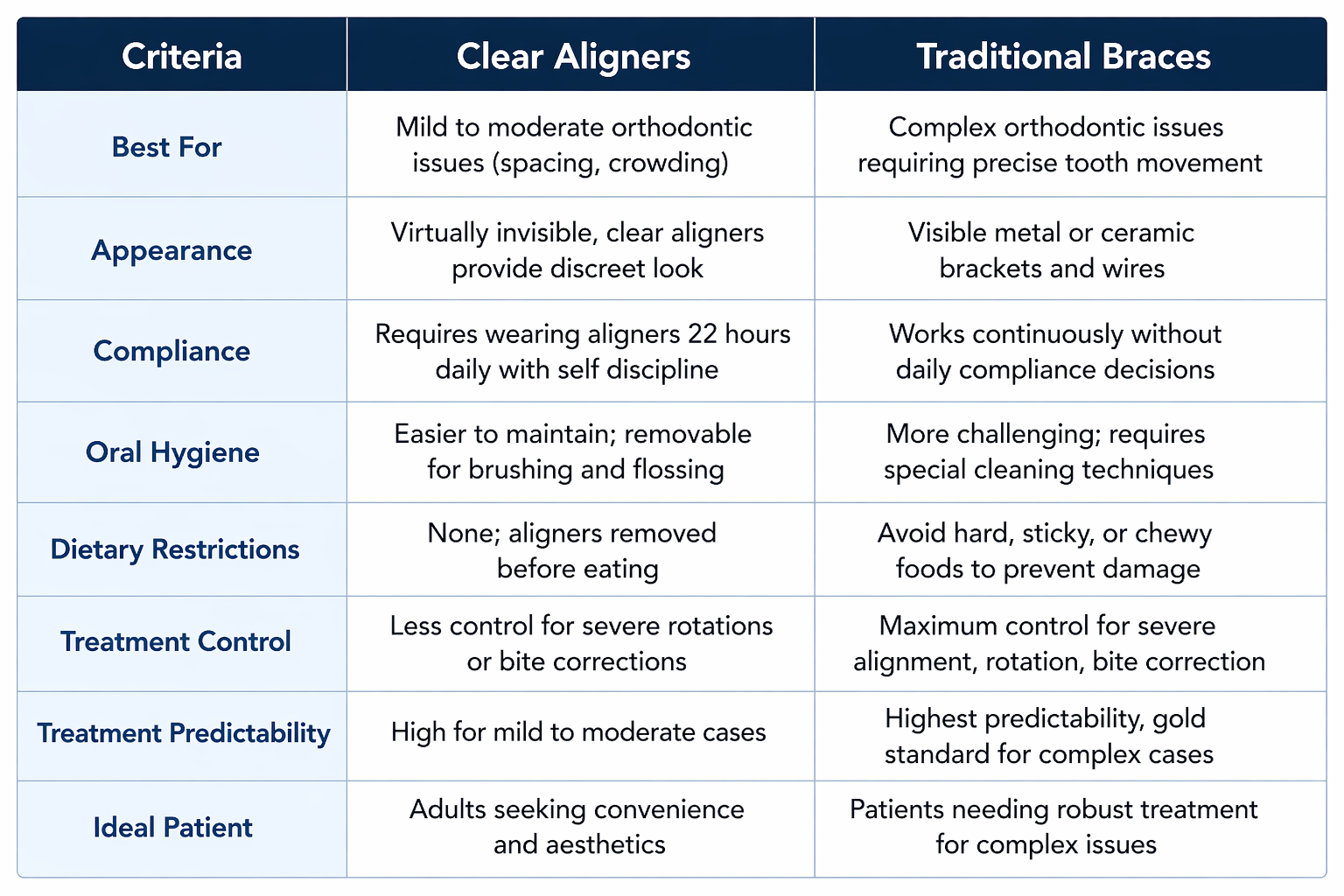
Traditional braces remain the right orthodontic treatment for complex cases requiring extensive root movement, significant rotations, or skeletal corrections. The continuous force delivery and three-dimensional control simply outperform aligners for these situations.
Both clear aligners and braces can achieve a confident smile when matched to appropriate cases. During consultation appointments at my Nashville practice, I walk patients through predicted outcomes, explain the limitations of each approach honestly, and help determine which treatment options align with their treatment goals and lifestyle.
What if you want the aesthetics of clear aligners- but need the control of braces? You cannot aren't disciplined enough to wear something 22 hours a day? You have tried clear aligners and it didn't work out? Consider lingual braces! Or even a hybrid style treatment plan where we use a combination of braces or aligners.
The best orthodontic treatment is the one that fits your specific treatment needs, addresses your orthodontic problems effectively, and works within your daily life. Whether you leave my office with aligner trays or brackets and wires, my goal at Starling Orthodontics remains the same: helping you achieve the healthy, beautiful smile you deserve.

Please call (615) 507-1660 or click below to schedule a consultaion appointment online.

Please call (615) 507-1660 or click below to schedule your complimentary orthodontic consultation online.


